
Kutani Ware Ceramics, the Pride of the Kaga Region
The traditional crafts capital that is Kanazawa is home to many of Japan’s great arts: kimono silk, gold leaf, Noh theatre, the tea ceremony… But it’s greatest pride and export might be one of the more misunderstood: Kutani ceramics.
Walk into a ceramics store touting “Kutani” in its name, and you’ll be met with a wide array of materials and designs that leave you wondering if only some of it is “real” Kutani. And if so, how does one tell the difference?
“Kutani ware” encompasses more than you might think, but to be able to appreciate how one minimally designed silver-layered vase of pale blue is as “Kutani” as the earthenware bowl with thick globs of glaze requires a bit of climbing up Kutani’s family tree.
Let’s start at the very beginning and with the most ancient pieces.
A Bold, but Rocky Start (1655 – circa 1700)
The Daishoji Domain was operated by a branch of the Kaga Province’s ruling Maeda Clan, and the domain itself made up the southern tip of the province, guarding against the Echizen Province (current-day Fukui Prefecture) to the south.
Little is known of Kutani-ware’s exact origins, except that production began under the direction of the domain’s first daimyō, Lord Toshiharu Maeda (son of the adored Lady Tamahime) that the kiln was located in the village of Kutani, and that a source of clay was near. Even less is known about why production disappeared for more than half a century.
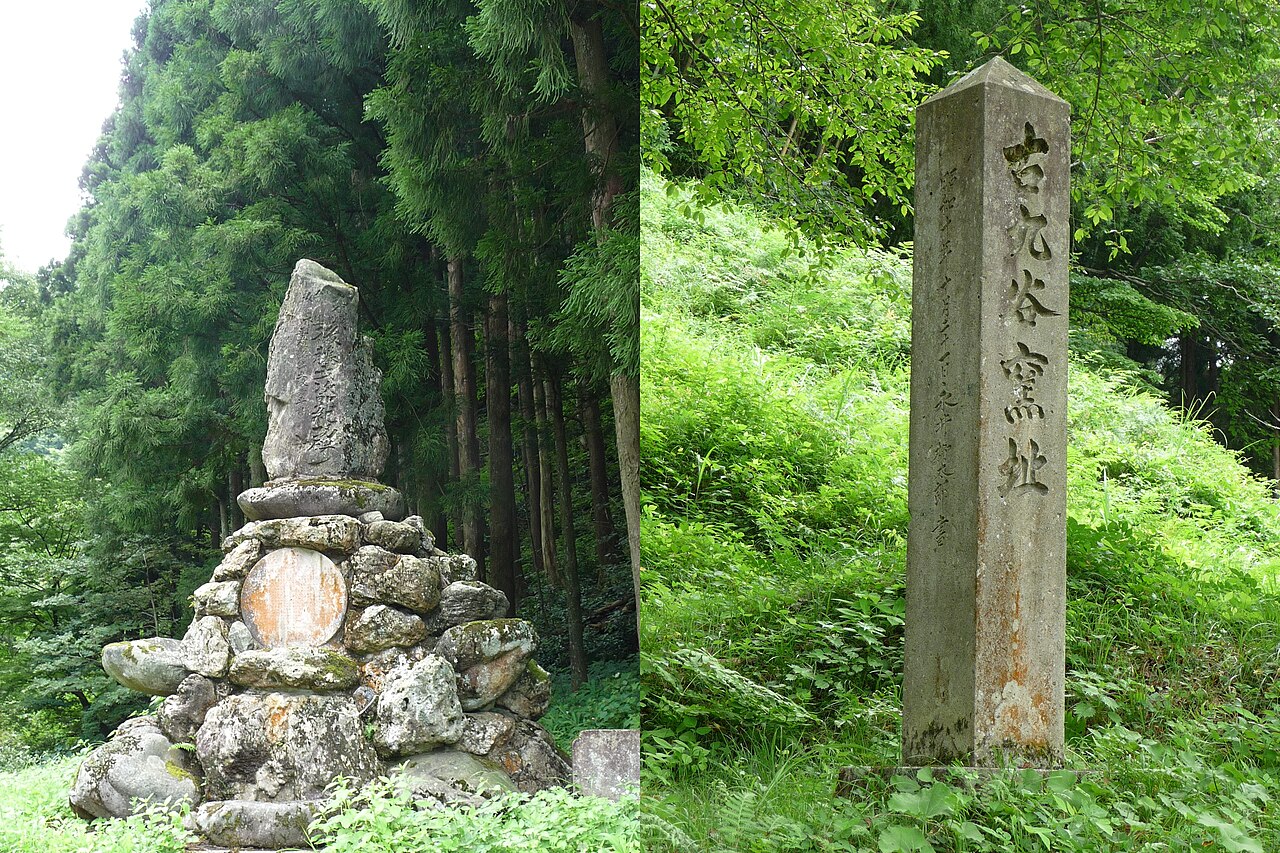
One proposed theory is that it may have been due to the policies of the Tokugawa Shogunate. In light of the Shimabara-Amakusa Rebellion, the shogunate viewed western religions as a destabilizing force. Upon discovering the Jesuit missionaries who introduced enamelling techniques to the Kaga area, the shogunate shut down production for a time. Another theory is that potters simply went elsewhere to study or worked in secret. Still another is that production was affected by a famine. In any case, no theory has yet been fully substantiated.
There has also been some contention as to whether the oldest Ko-Kutani designs originated in Kutani Village or came from Arita in Kyushu, which later produced Imari-ware. Investigations as recent as 2024 confirm that, aside from the common influence on both kilns from the introduction of European smalt (cobalt colored overglaze blue enamaling), the two kilns exchanged techniques and ideas, with Arita refugees introducing potting and glazing techniques to the Kaga region, and the Aote style (the first distinctive style of Kutani ware) heavily influencing potters back in Arita. In the centuries since, each area has evolved unique designs and combinations of techniques that have become the characteristic craft of their respective regions.
The pottery from this earliest period is referred to as “Ko-Kutani,” literally meaning “old Kutani,” and was produced at the old Kutani Kilns, deep in southern Ishikawa Prefecture. Ko-Kutani, and much of what will be Kutani thereafter, is distinquished by the use of overglaze ceramics, encompassing both stoneware and porcelain pieces. The two styles most connected with this period are Aote and Iroe, and they use traditional Japanese overglaze paints called waenogu, notable for their translucency and three-dimensional appearance.
Aote, “Blue/Green Technique”
The most well-known style specific to Ko-Kutani is Aote (sometimes pronounced “Aode”), literally meaning “the technique of blue/green.” Only a maximum of four colors are used: green, purple, Prussian blue, and yellow. Images are drawn with a fine brush, and globs of of waenogu paint are brushed on top. Despite the thickness of the glaze, it bakes into a translucent color, allowing the drawn lines to be seen undernearth. It has sometimes been nicknamed “Japanese oil painting.”
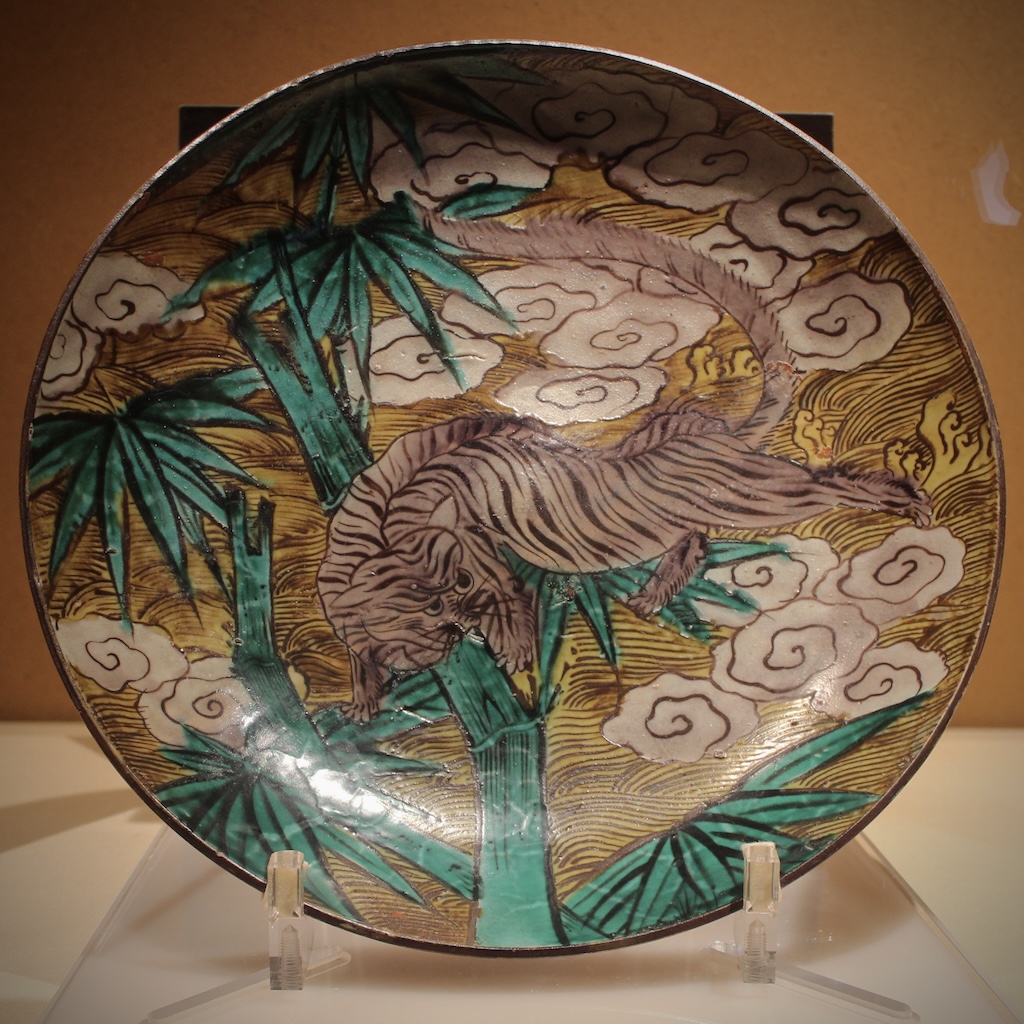
Aote’s dynamic designs were said to express the boldness of the samurai warrior class. The style would return in the early Kutani Revival period as a specialization of the Yoshidaya Kiln and the later Matsuyama Kiln, which belonged directly to the Daishoji Clan. Early Yoshidaya works in particular has become synonymous with the Aote style.
Iroe, “Colored Pictures”
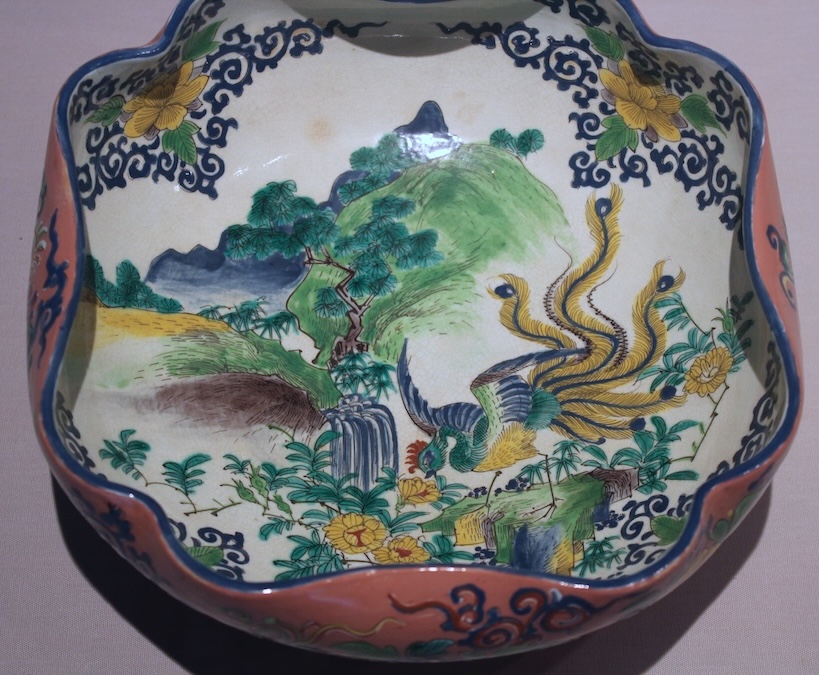
Also known as Gosaide, or “The Five Paints Technique,” Iroe used the four colors of Aote plus red. Composition tends to follow the Chinese style of ample white space with nature (particularly landscaps, bird and flowers) and people as central images. Eastern art historians may notice the direct influence of then-contemporary Japanese art schools of Kano, Tosa and Rinpa in the aesthetics. Although it began as a Ko-Kutani style, it remains the most popular and identifiable style of Kutani to this day.
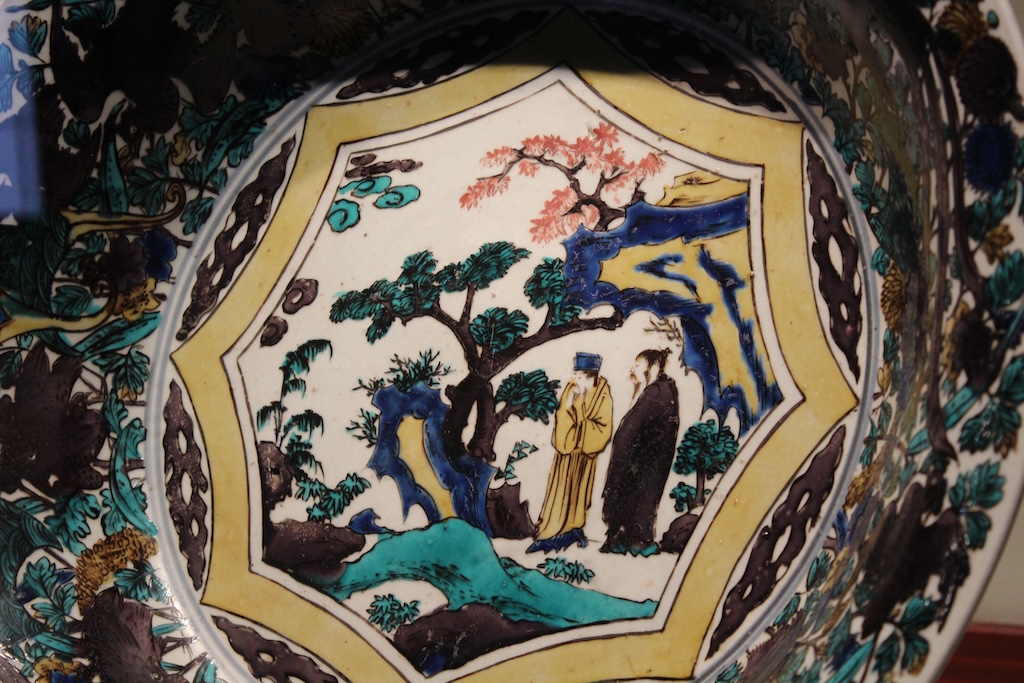
The red in the earliest pieces is often used sparingly as as a point of interest, such as the autumn-changing leaves of the maple tree.
As with Aote, Iroe was also revived during the early Kutani Revival period, and remains the quintissential Kutani-ware style, so much so that even later works that follow this style are still referred to as “Ko-Kutani.”
The Kutani Revival (1806 – present)
The Kutani Revival, greatly supported by the Kaga Province’s ruling Maeda Clan, resulted in the existing works on display in the prefecture’s many museums as well as the traditional methods still used in contemporary Kutani-ware production.
1807 – 1820 Kasugayama Kiln, Kanazawa; start of Kutani Revival; Mokubei, a painter from Kyoto was brought to Kanazawa, and the potter, Sadakichi Honda, pulled stone from Hanasaka Village (current day Komatsu), which is still a source of quality Kutani-ware stone today.
While Mokubei brought a fresh aesthetic to Kutani-ware design in the province’s capital, a merchant named Denemon Toyoda (Yoshidaya) revived production of the more traditional ko-Kutani styles, particularly Aote, in 1823, building the Yoshidaya Kiln, which began full production three years later. This same kiln would continue on, changing family names and schools of production over the course of generations.
The first to inherit the Yoshidaya Kiln—undoubtedly the most influential and famous—would be the Miyamoto school, developing the delicate and precise linework of Akae, which exploded in demand, allowing Kutani-ware to further thrive, lasting from 1832 to 1859.
The then Miyamoto Kiln then became the Kutani-hon Kiln, also known as the Yamashiro Kiln based on its location. It is the one used by Wazen Eiraku from 1865
.
.
.
.
.
late Edo period:
…

About a decade ago Rachel fell off a bus and then fell in love with this traditional-crafts and ice-cream-consuming capital of Japan. Editor and amateur photographer with a penchant for nature and history. Not actually fifty songbirds in a trench coat. (Former penname: Ryann)